BEYOND THE SCHOOL HOURS AND THE APPEARENCES:
Road between the feelings and the thoughts of the 4H
A coloro che ci tramandano le loro conoscenze
a coloro che sono disposti a leggere
a coloro che almeno una volta si sono chiesti cosa pensa uno studente
a coloro che sono insegnanti e amici
vogliamo comunicare qualcosa che non siamo mai riusciti a condividere
vogliamo dedicare parole e idee
vogliamo esprimere cosa pensiamo per dire cosa proviamo
vogliamo dire di noi
The themes of war and peace
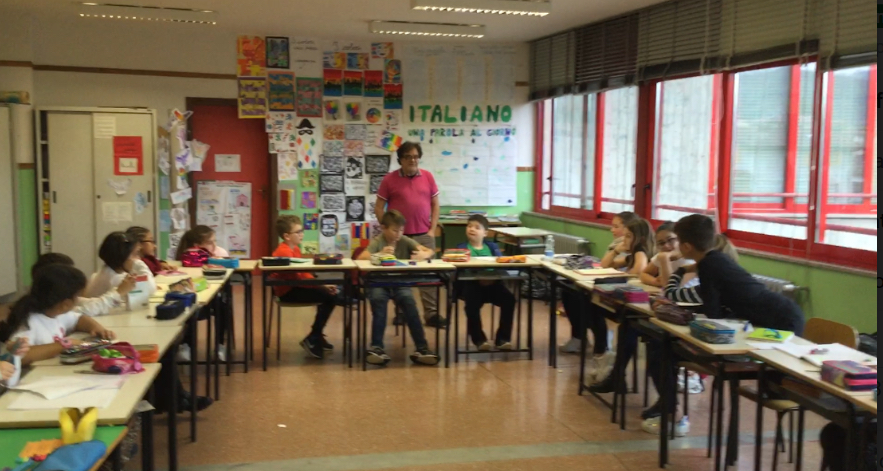
Dear teachers, thanks to the help of Mrs Garuffi, we discovered a new way of learning in the classroom. This text was born from a collective writing project carried out in class, in which everyone contributed with their own ideas, opinions, and proposals. By working together, we were able to find a common ground, learn without feeling judged, and express emotions we often tend to hide. In this text, the main theme is conflict and everything that comes with it: enemies, hatred, war, but also peace.
Have you ever stopped to think about what conflict really is? Thanks to this project, we did. Thanks to a pen and a piece of sheet, we put in writing our deepest feelings and reflections, without being tied by the fear of being judged.
After some lessons in the classroom, we arrived to some conclusions that war is:
– a situation where you are in a different position from another person
– many different points of view
– when someone hates or dislikes someone else
– it is like a storm
– could be physical or verbal
– it makes people not feel free to be what they want
– something you are fighting for
– it can be interior with yourself
– situation in which people do not feel safe
– a situation where both want to win

But conflict isn’t necessarily related to war, in fact we realised that we can be at war even in the class and we learnt how painful a juvenile conflict can be between classmates and teachers. After our reflections, we think that this happens because:
– we are all different
– there are many different personal ideas so it is inevitable
– there are some divisions that create tension
– someone could be envious or jealous
Therefore, if we suffer so much for minor conflicts, could you imagine how much pain people experience in real conflicts, like in Gaza, Ukraine or the one that happened in Bosnia and Herzegovina? They have been at war for different reasons, such as political, religious, ethnic, economic…
So, we asked ourselves: are we at war with something
And we got to a conclusion:
– with ourself because we want to be our best version
– fear of death
– our mental health
– our own thoughts
– nothing comparable with words
– food
– my body
– we are always at war because is against feelings and situations
– with emotions
– with my soul
– with nothing

During the exhibition Prophecies of Peace, an exhibition which was shown in Rimini for all secondary school students and where one of the guides was our classmate Beatrice, we learned that peace is a gift every human being deserves to experience. The contrast between love and war, represented by the Palestinian and Israeli mothers who lost their sons at the border because of the conflict, showed the world that peace can rise even above the cruelest violence. Their pain became a message of hope: even in the deepest darkness, we can still choose to be a light.
We all deserve a world filled with peace, even if each of us finds it in different moments, people, or small details of life. And this is the question that stayed in our hearts during our lessons: When do we truly have peace?
-when there is nothing to worry about
-when I am in my favourite place with my favourite people
-when we start caring of other people
-when people decide to forgive each other
-peace isn’t built from above but from the bottom
-where no one wants to overlove somebody
-when there is respect
-when the desire of power don’t overcome the beauty and love
-when we are in peace with ourselves and our soul
-when we understand that the person we are shooting at is like us, with family and passions
-when I am alone in some beautiful place
-when we start identifying with other people
-when no one want to be superior to the other
-when we stop being blind for hating
-when people break the cycle of revenge
–when people live in harmony together

The meaning of feeling at home in school
During our English lessons we saw a movie called “Freedom writers” and we reflected about the character of Mrs.Gruwell. We think that Mrs. Gruwell is a really good teacher because she was empathic, kind and altruistic.
She managed to create a safe place for her students by giving them opportunities to express their thoughts and by following this method she made them interested in literature, reading and writing in English.
We also discussed what makes her a good teacher: Mrs.Gruwell believed in her students without judging them and she made them realize their place in the world. She used her heart because she wasn’t focused on grades but she believed that her students were important to her, not only strangers and numbers.
We compared the character of Mrs. Gruwell to our reality and we talked about what makes a teacher a great teacher. For all of us it is easier to study with a teacher that transmits the passion for the subject that she teaches.
Some students think that it’s difficult to follow this teaching method and others think it is easier. It may be difficult for some students because it requires you to trust the teacher blindly, not knowing if she may judge you or not. Another thing is that this method needs constant hard work to be maintained.
In one of our lessons of “Collective writing” our English teacher made us see again a short part of the movie in which a character, Tito, returns to school after the summer holidays, after he and his mum have lost their home and exclaims “I’m at home now!” Our teacher asked us whether we feel at home at school, what or who is “home” for us, and if we are “home” for somebody. Most of us think that at school we have to play the role of being good students because everything we do is always judged by a mark. We also think that school is an important place but there we can’t really be ourselves. Other students think that you can be at home because at school you are surrounded by your friends. Because of this, school can be less hard because you are not alone. Instead, we are at home when we are with our favourite people because they don’t judge us. Many students feel at home when they are with their closest friends or with their family because they share love with them.
The last question we asked ourselves was: “Why and when can we say we are a home for someone?”
There were many personal answers, here they are:
“I’m home for someone, because I stay with her every moment, not just the good ones, but also the difficult ones.”
“I would like to be home for someone because I want to make them able to trust me”
“I’m home for him/her because I love these people for what they really are, and I don’t want them to change just to appear in another way.”

“I would like to be home for someone since it is a good thing to know that you can rely on someone, that you know you can trust somebody knowing that you have someone that has your back is something precious”
“I think I can be home for someone when I transmit this and when I try to make someone feel loved and safe.When time that we spend together feels necessary and can let go away bad feelings”
“I’m home for many of my friends because I’m the one that listens to every problem they have because I can be trustworthy and when ever someone needs help I am there for them”.

Young love & old hatred
Firstly we want to reflect on the fact that love can be young and hate old.
This idea came up from the tragedy Romeo & Juliet that we have studied during this school year. Some of us think that it is true that young people, like Romeo and Juliet, can experience a powerful love stronger than the old hate between their families.
“The hate is old because it began many years ago, new and real emotions should overcome conflicts” because “you don’t have to continue a war that you never started”.
We also thought about the maturity of the two lovers because they decided to be out of the conflict of their families choosing not to be influenced by the old hate of their relatives and to follow their hearts. Secondly we analyzed the influence of our families in our decisions in love. We were pretty divided on this topic. The reason for this was that we also took into consideration the facts that happened in March near Bergamo where a 13 year old student stabbed his French teacher, filming the action. We were shocked by the letter that this student had written before committing that awful gesture, as well as we were moved by the letter that the teacher wrote to him, in which she forgave the boy. Is it always true that love is young and hate is old? In this specific case it’s just the opposite. Hatred can be young too. This hatred comes from the perception that we are often tired of everything, because everything is never enough. Sometimes we are so tired that we would almost like to disappear as fast as we can. As that boy from Bergamo, we also need a loving gaze, someone who takes good care of us, a forgiveness may be…


The brick to build with
As we reached the conclusion of our project, we focused on a recurring theme that deeply affects every single one of us: “the bricks we carry inside.” Accompanied by the listening of “Il Mattone” by Angelica Bove.
“It’s never enough… I just would like to disappear.”
“The biggest brick I carry inside is the weight of never feeling good enough.” “Without suffering, we wouldn’t be able to recognize beauty.”
“As hard as it can be to accept defeat, we must always remember that human beings are not meant to be perfect.”
“We shouldn’t erase our mistakes; we must learn to make them a part of who we are.”
“We are like bricks—when we connect with the right people, we build a structure together”
“This brick gives us a strong sense of responsibility and the strength to fight back and win.”
“Every time I look in the mirror, I feel like I’m suffocating.”
“I believe the most important step is to talk to someone about it and try to find a positive takeaway to help us grow.”
“Once we manage to accept it, we will be able to build something stronger within ourselves.”
“Carrying the weight of a brick is a sign that we need to start building something new, even if it is difficult.
These are just some of the thoughts that emerged from our personal notes.
The reflections gathered during our project show that pain and suffering are not just negative elements, but can be transformed into opportunities for personal growth and rebirth. We noticed that many of our classmates expressed feelings of inadequacy and discouragement. However, analyzing their words we can see that many of these thoughts are actually the first step to understand ourselves and grow as individuals.
The workshop also highlighted the importance of having someone to confide in. In fact, some believe that sharing our problems with others helps lighten the weight of the brick we all carry. Another significant element involves the value of mistakes and defeats. Society often pushes us to chase perfection, but several reflections pointed out that human beings are simply not meant to be perfect. The statements prove that every experience, even the most painful one, can become part of a journey toward personal development. Our inner bricks, therefore, represent not only the weight of our struggles but also the opportunity to build who we are. Learning to live with our problems allows us to develop greater emotional strength. Only by accepting our imperfections can we turn difficulties into solid foundations for the future and build authentic relationships with others.


Mattone
di Angelica Bove
Dicono che per amare serve stare bene da soli
Di non accontentarsi pur di rimanere insieme da fuori
Noi ci somigliamo come i cani coi padroni, ah
Ma non ci capiamo come figli e genitori
Mi prendo un altro po’
Troppe informazioni che mi confondono, ah
Quanta pioggia ancora cadrà
Per un po’ di pace in queste giornate, ah
So che prima o poi passerà
L’ha detto il dottore che mi devo abituare
A stare male in modo normale
Come tutte le altre persone
A stare male in modo normale
Come tutti gli altri
E ritornare a vivere
Dicono che per odiare serve litigare
Servono parole dette bene
Io che mi ritrovo sempre a dire cattiverie
Fino a tre non riesco mai a contare
Perdo la pazienza come perdo le occasioni
Sono treni così lontani
Aspetto ancora un po’
Troppe direzioni possibili
Dicono che porto un peso
Che per me è un mattone
Ma un mattone serve a costruire.